Wrapping Up RAD I: Reflections From the Other Side of the Classroom
May 28, 2026
Campaign Influence QA Checklist: 12 Failure Tests Before You Trust the Dashboard
June 23, 2026
Hidden Fields vs Salesforce UTM Touchpoints: Where DIY Tracking Breaks
For a lot of teams, hidden fields were the first practical way to get UTM values into Salesforce reporting. They are familiar, quick to launch, and often good enough to prove early channel performance. The core problem is not that hidden fields never work. The core problem is that they are brittle and prone to implementation drift, and they usually capture only the touch closest to the form fill instead of the full engagement journey.
When your team starts asking deeper questions like "What happened between first visit and closed won?" or "Which middle touches moved the deal?" that form-proximity capture model quickly shows its limits.
This post is a practical comparison of where hidden-field tracking helps, where it breaks, and when it is time to move to a touchpoint model.
What Hidden-Field Tracking Does Well
Hidden fields can be a useful starting point, especially in simpler environments.
They are strong when:
- You only need last-touch reporting.
- Your web footprint is small and controlled.
- Your sales cycle is short and relatively linear.
- You mostly need directional channel insights, not detailed journey analysis.
For small teams, this can be enough for a while. If your core question is "Which channel drives form submissions?" hidden fields can answer that quickly.
Where the DIY Pattern Breaks in Production
As soon as your attribution use case expands, hidden fields tend to fail in a few predictable ways:
You capture snapshots, not journeys
Most hidden-field setups preserve one or two values (first and/or latest). Real buyer behavior is usually multi-touch. When only snapshots survive, middle engagement disappears from attribution.
Form dependency becomes a blind spot
If capture depends on form submissions, engagement before and after forms is often underrepresented. That creates a distorted picture of influence, especially for longer B2B cycles.
Cross-device journeys break first-touch form logic
First-touch reporting through forms often fails when the same person engages across multiple devices. A common pattern is: ad clicks on mobile, then another click on desktop, form fill on desktop, then later email engagement on mobile.
Your marketing platform may eventually know these sessions belong to the same person, but the form-based UTM capture can still stamp the first desktop touch as "first touch" and miss the earlier mobile path. That is not a small edge case in B2B; it is normal buying behavior.
Inconsistent implementation creates data drift
DIY scripts and hidden fields are rarely implemented perfectly across all forms, pages, microsites, and redirects. The two most common failure modes are broken forms (where capture logic does not fire as expected) and missed mapped fields (where values land in the wrong destination field, or not at all).
Over time, these implementation gaps create silent data drift. Reporting still runs, but attribution quality degrades because your data capture is inconsistent by form, template, or channel.
Maintenance burden compounds quietly
Browser behavior changes, form updates, new page templates, and team handoffs all create hidden maintenance work. The result is attribution debt: everything still "runs," but reliability degrades.
Timing and relationship gaps remain unresolved
Even when UTM values land on a lead/contact, that does not automatically solve campaign member timing, OpportunityContactRole (OCR) coverage, or influence readiness.
What a Touchpoint Model Changes
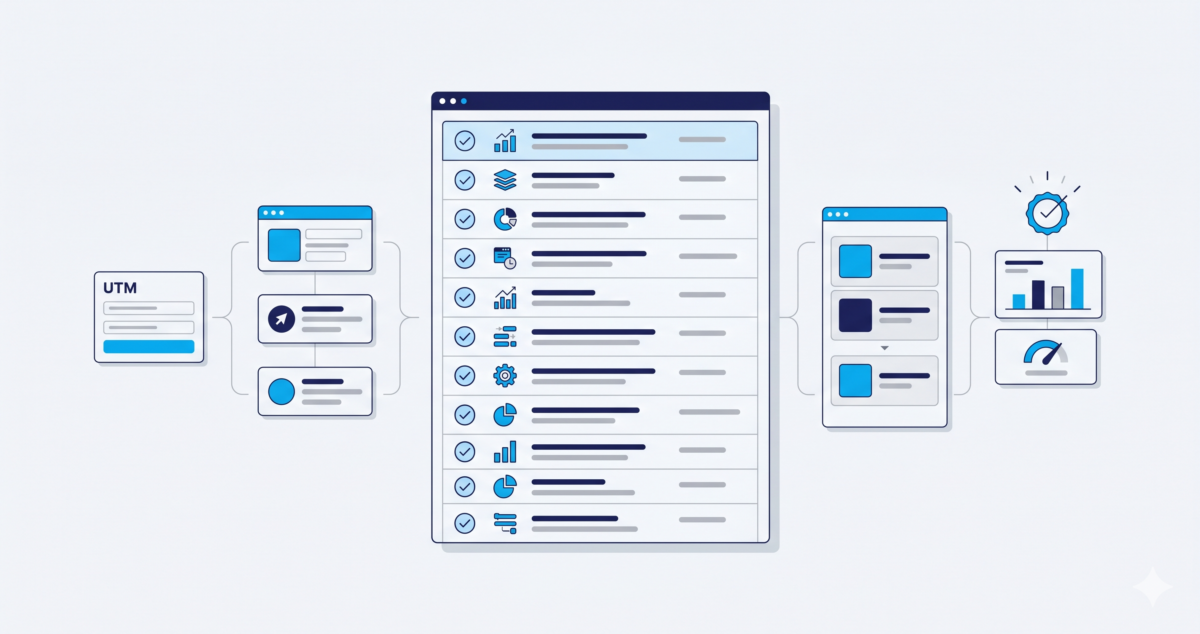
A touchpoint model changes attribution from "field values at a moment in time" to "engagement records over time."
In practice, that means:
- Each qualifying engagement is stored as its own timestamped record.
- UTM context is preserved as part of the event history.
- Campaign matching can be explained and audited.
- Reporting can include pre-form and post-form engagement behavior.
- Journey analysis becomes possible without flattening everything into a couple of fields.
This matters because attribution strategy depends on digital engagement fidelity. If UTMs are your source signal for engagement, preserving them as a timeline is usually more reliable than repeatedly overwriting a few fields.
A Practical Comparison
| Area | Hidden Fields | Touchpoint Model |
|---|---|---|
| Data shape | Snapshot fields | Event timeline |
| Typical output | First/latest touch | Multi-touch journey |
| Form dependency | High | Lower |
| Campaign matching transparency | Limited | Higher |
| Auditability | Moderate | Stronger |
| Scalability over time | Fragile | More durable |
When to Move Beyond DIY
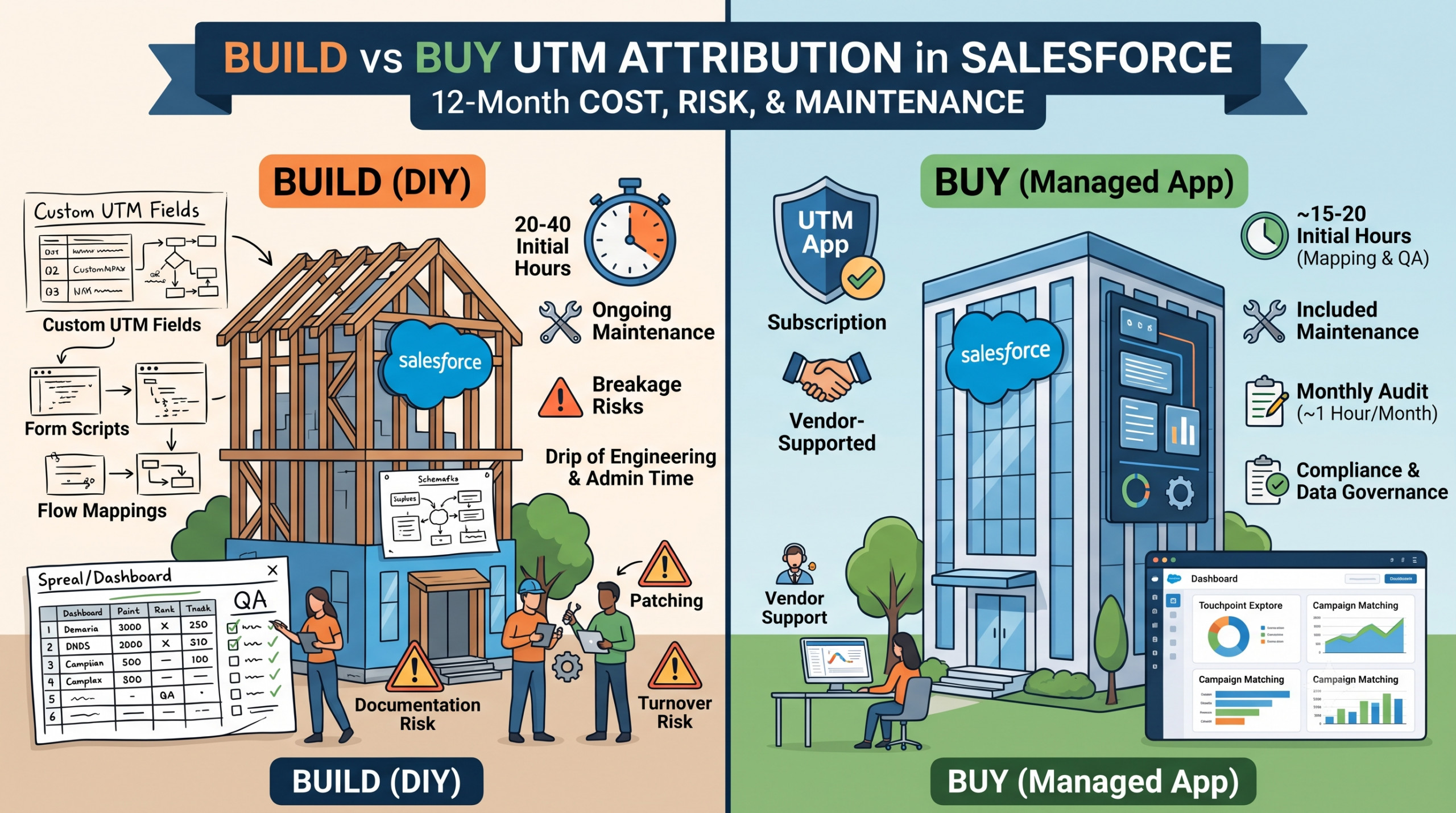
You do not need to switch approaches on day one. You should switch when the cost of "good enough" becomes higher than the cost of improving reliability.
Common tipping points:
- You are managing multiple channels and campaign owners.
- Leadership asks for pipeline and revenue influence, not just form volume.
- You need to explain attribution changes quarter over quarter.
- Unmatched or inconsistent UTM values are rising.
- Teams debate dashboard credibility more than they use the insights.
- You are spending too much time reconciling data manually.
When these patterns appear, hidden fields are usually no longer a system. They are a patch.
Salesforce attribution is only as trustworthy as the data path feeding it. Hidden fields can get data into Salesforce, but they often cannot preserve enough journey context to support mature attribution decisions.
A touchpoint model does not magically fix everything. You still need good taxonomy, matching discipline, CampaignMember timing, and OCR coverage. But it gives you a stronger foundation for those processes to work consistently.
Where our UTM App Fits
If your team is already feeling the limits of hidden fields, our UTM app is designed to support the touchpoint-first model described in this post.
A simple before/after example:
- Before: a cross-device journey gets flattened to a form-time field value, and earlier engagement is hard to see in reporting.
- After: timestamped touchpoint records are preserved in Salesforce, so campaign matching and influence analysis have full journey context.
The goal is not to "add another tool." The goal is to reduce brittle capture logic and make attribution data easier to trust.
Hidden fields are not wrong. They are often just incomplete for where teams eventually want to go.
If your organization is moving from channel reporting to true influence reporting, the key shift is this: stop treating UTM data as a couple of fields to stamp, and start treating it as digital engagement history to preserve.
That shift is usually where attribution becomes credible.
If you want a practical next step, audit one recent closed-won opportunity and map what your current setup actually preserved from first engagement to influence reporting. The gaps are usually clear in one pass.